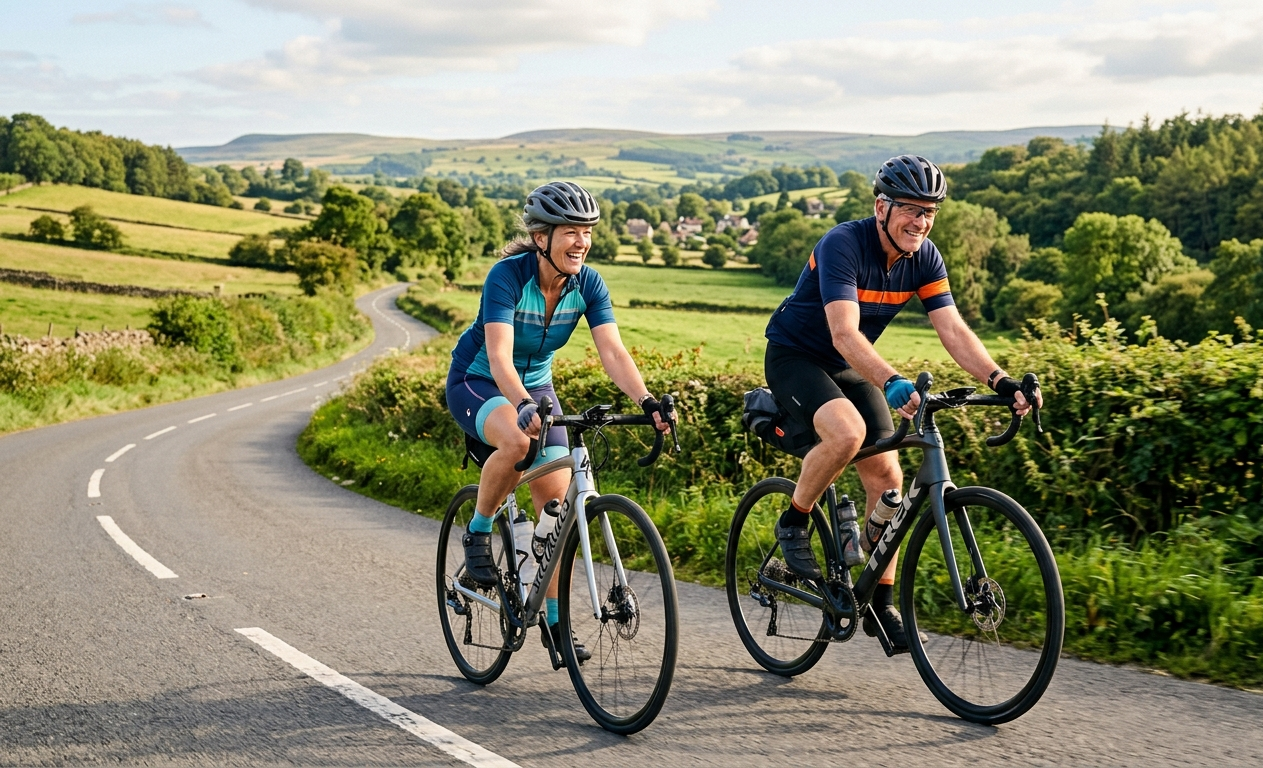
In short, if your questioning whether you can get back to cycling after a age related hiatus…Yes! you absolutely can get back on a bike in your 50s, 60s and beyond. Cycling is one of the most joint-friendly forms of exercise there is, the right bike makes hills a non-issue, and alot of our older customers returning to riding tell us pretty much the same thing ” I wish I’d done this years ago!”.
We’ve been selling bikes in Cornwall since 1970, which means some of our customers have been riding with us for half a century, and plenty more walk through the door after twenty or thirty years away from the saddle. This guide is written from those conversations: what actually holds people back, what actually helps, and what we’d advise a friend over a cup of tea rather than repeating what a bike brochure says.
Is cycling good exercise for over 50s?
It’s arguably the best mainstream exercise for this stage of life, and the reason is mechanical: cycling is non-weight bearing. Unlike running or even long walks, the saddle carries your body weight, so your knees, hips and ankles get all the benefits of movement with a fraction of the impact. That’s why physiotherapists so often point people towards a bike.
The benefits stack up quickly: cardiovascular fitness, leg strength (which protects balance and independence as we age), better sleep, and the mental lift of being outdoors — something Cornwall supplies rather generously. Because you can precisely control the effort, cycling suits almost any starting fitness level; a gentle ride is genuinely easy-going and progress comes without a pounding effect on your body like running.
The sensible caveat: if you have an existing heart condition, joint replacement or other significant health issue, have a quick word with your GP before starting, not because cycling is risky, but because they can help you pace your return. For nearly everyone, the answer will be an enthusiastic yes.
What’s the best bike for an older beginner or returning rider.
The best bike is the one that removes your particular reason for not riding, after years in the cycling trade, we get this question alot and it can generally be split into three reasons.
If comfort is the concern: Buy a modern hybrid
Forget the last bike you rode. A modern hybrid bike puts you upright rather than hunched, with wide, cushioned tyres, forgiving gearing and stable handling. It’s the natural choice if your riding will be the Camel Trail, quiet lanes and gentle leisure miles, and its the most affordable way back in.
If hills are the concern: Get an electric bike
In Cornwall, hills end more cycling comebacks than anything else, and the e-bike has solved this. The motor amplifies your pedalling (you still get genuine exercise) and turns the climb out of your village from a dealbreaker into a minor detail. If you’re hesitating because you remember what our hills feel like, this is your answer, and it’s why the over-50s are among our most enthusiastic ebike customers.
If getting on and off is the concern: a step-through frame
Trapeze and step-through frames are available in both regular and electric versions. These frames allow you to walk through the frame rather than having to swing a leg high over the saddle. Less flexible hips, a knee that complains, or simply wanting a dignified stop at junctions: all solved with these frame geometries. No one who chooses a step-through ever tells us they regret it.
Whichever cluster you’re in, the real answer is a taking a test ride. Ten minutes on the right bike does more than any amount of reading up on the right bike for your age. Come and try a few at our Summercourt store.
Are e-bikes cheating?
Let’s tackle the question directly, if mobility and/or fitness stops over-50s from getting on the bike for some exercise, surely an electrified version removing the barrier to entry is a great thing. The motor doesn’t remove the effort; it removes the various reasons not to go out cycling at all.
You still power the pedals, your heart rate still rises, the motor only works whilst your exerting energy. On lower assistance settings you can work precisely as hard as you choose. The headwinds, the hills, the tired legs after work — an ebike ensures these factors dont influence your decision to cycle or not.
If pride is the last obstacle, pop up Summercourt for a test ride up a proper Cornish country road hill and see how “cheating” feels at the top.
How do I build cycling fitness after years off?
Slowly, pleasantly and without a training plan that feels like homework. The single biggest mistake returning riders make is doing too much in week one, overdoing it, and quietly shelving the bike to recover. Here’s the approach that could help the habit actually stick:
Weeks 1-2: little and often. Two or three short rides, 20 to 30 minutes on flat, traffic-free routes. If your in Cornwall reading this, the Camel Trail is perfect for this. The goal isn’t fitness yet; it’s re-learning that riding feels good and letting your body (particularly your buttocks!) re-adjust to the bike saddle.
Weeks 3-4: stretch out one ride. Keep the short rides, but let one weekend ride grow toward an hour. Add gentle undulations rather than extreme gradient hills.
Week 5 Onwards: Listen to your body. Extend distance by roughly 10-15% a week if you feel good, and perhaps only 5% if your fatigued. Consistency beats heroics, three modest rides a week builds far more fitness than one epic ride followed by 5 days of recovery.
Listen to your body throughout: mild muscle tiredness is progress, joint pain is a signal to ease off and possibly check your bike setup. Which brings us to the section most returning riders skip.
Comfortable bike setup for older riders
Here’s something we see weekly: someone abandons their comeback because of a numb hand, an aching knee or a sore back, and go on to blame their age. When the real culprit is their bike set up wrong. Almost every “I’m too old for this” pain has a mechanical fix:
Sore knees usually mean the saddle is too low (very common) or too high.
Numb hands and aching shoulders usually means too much weight on the handlebars, the arm reach is too long or the bars are too low. Lower back pain often traces to the same stretched out position as above. Saddle discomfort is usually the wrong saddle width, or sometimes not enough time on the bike to let the glutes adapt.
You can chase these adjustments by trail and error, or measure them properly. Our Retül fitting studio uses motion-capture technology to analyse how you actually move on the bike and set every contact point to match. While most people assume bike fits are for racers or triathletes, comfort fitting for returning and older riders is some of the most rewarding work we do. Bodies change over the years; the bike should be set up for the body you have now, not the one that last rode.
Is it safe to cycle on Cornish roads?
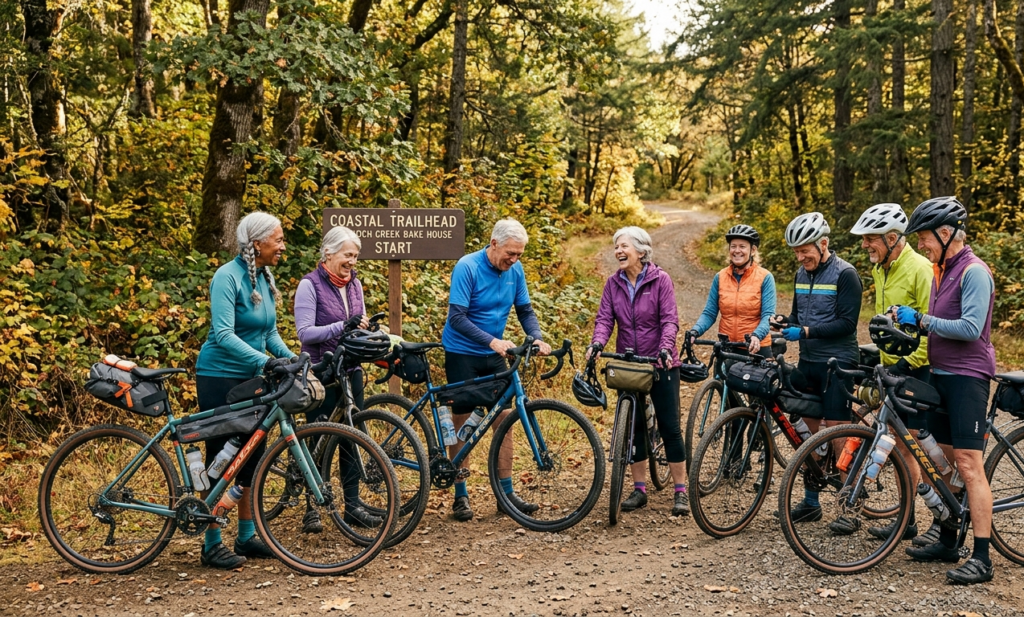
An honest answer: Cornwall’s roads are a mixed picture, and the good news is you can choose your mix. Yes, some A-roads are busy and best avoided, especially with the compounding effect of summer traffic. However, Cornwall also has one of the best networks of quiet lanes and traffic-free trails anywhere in Britain, you can enjoy a rich riding life while barely touching a main road.
Start traffic-free: the Camel Trail (Wadebridge-Padstow-Bodmin), the Clay Trails around St Austell, and the Coast to Coast route offer miles of car-free riding whilst confidence builds.
Then add quiet lanes: Cornwall’s web of single-track lanes carries little traffic in the off-season. Ride without distractions like headphones, concentrate and be aware of your surroundings and oncoming cars. Position yourself well on the track so cars can see you and these lanes can be a joy to ride.
Stack the odds in your favour: ride outside peak times, use good lights even in daytime (modern USB lights are good for this), wear something bright, and let someone know your route on longer rides. Confidence is key.
Thousands of riders your age ride these roads and lanes happily every week. Start where it’s calm, and grow from there.
Frequently Asked Questions
Can I cycle with arthritis or stiff knees?
Very often, yes. Cycling’s smooth, low-impact motion is frequently recommended for arthritic joints because it moves them through their range of motion without impact. Many riders find regular gentle cycling eases stiffness rather than aggravating it. The details matter: correct saddle height, low gears (spinning easy cadence rather than grinding in low gear), and an e-bike to take the strain off climbs all help enormously. Check with your GP or physio for your specific situation.
Can I ride a bike after a hip or knee replacement?
Many people do, and cycling is commonly part of post-replacement rehabilitation, but the timeline and the greenlight to do it MUST come from your surgeon or physiotherapist, not from a bike shop or this blog. Once your cleared, we can genuinely help: step-through frames remove the awkward leg-swing, careful saddle and crank setup keeps the joint in a comfortable range, and an e-bike takes the load off. Tell us your situation, it changes our recommendation.
How much does it cost to get back into cycling?
A quality hybrid that will serve for years starts from around £400-£800; step-through and comfort frame models in a similar bracket; and e-bikes from established brands start around £1800-£2500. Add a helmet, lights and a lock — budget £100 or so — and that’s genuinely it: bar the annual service, there’s no fuel, no membership, and the running costs are pennies. The Cycle to Work scheme can reduce the outlay substantially if you’re still employed. Buy once from somewhere that will size you, set the bike up and service it, and the cost per happy mile gets very small indeed.
Am I too old to start cycling?
No, we’re yet to meet the customer who is. We advise and sell bikes to riders in their 70s and 80s, including plenty who hadn’t ridden in decades. E-bikes keep extending what’s possible. Fitness can be built at any age; balance can be accommodated (step-throughs, wider tyres) and the health case for starting arguably gets stronger with age, not weaker. The best time to start cycling is today; the second best time is this weekend.
Ready when you are
The pattern we see, year after year: the hardest mile is the one between your front door and our shop. Come in to our Summercourt store, tell us honestly where you’re starting from… which hills worry you, which knee that complains, the decades since you last rode, and we’ll put you on bikes until one feels right. No pressure, no jargon.
If you have a heart condition, are recovering from surgery, or have any health concerns that make you think twice about starting, have a quick chat with your GP before starting. Then come and see us.