
If you’ve been shopping for a full face mountain bike helmet, you’ll have seen “ASTM F1952” listed in the specification. Usually alongside EN 1078 and CPSC, and nine times out of ten with no explanation of these codes. This guide covers what the standard is, why it matters for downhill riding, and how to check whether a helmet carries it.
What is ASTM F1952?
ASTM F1952 is the international standard for helmets used in downhill mountain bike racing, published by the American standards body ASTM International. It exists because downhill riding carries a higher risk of head and face injury than road or leisure cycling, so the standard demands greater impact protection than the certifications applied to ordinary bike helmets. It also sets performance criteria for chin bars on full face helmets —the only mainstream cycling standard that tests the chin bar at all.
Two details worth knowing. First, F1952 does not actually require a helmet to be full face; it is a performance standard, not a design rule, which is why a small number of open face helmets have passed it. Second, compliance is all or nothing, a manufacturer cannot claim partial F1952 certification. If a helmet says F1952 on the label, it passed every test in the specification.
Who sets the standard?
ASTM International, formerly the American Society for Testing and Materials, a body that publishes voluntary technical standards across hundreds of industries. F1952 is reviewed on a rolling cycle (no pun intended) and revised periodically, which is why you’ll sometimes see a year suffix attached such as F1952-15 or F1952-22, that’s the revision the helmet was tested against.
Why does an American standard matter in the UK?
Because Britain has no downhill-specific helmet standard of its own. EN 1078 covers general cycling, and nothing above it exists in UK or European regulation for gravity riding. Helmet manufacturers selling worldwide therefore use F1952 as the de facto global benchmark for downhill protection, and it’s the certification UK riders should look for when buying a helmet for bike park and downhill use.

ASTM F1952 vs EN 1078: what’s the difference?
EN 1078 is the baseline standard that every bicycle helmet legally sold in the UK and EU must meet, from a £20 lid to a £500 downhill helmet. It certifies a helmet as safe for general cycling. It does not test chin bars and it is not designed around the impact force and speeds of downhill riding.
ASTM F1952 sits above it. The impact tests are more demanding , and full face helmets must additionally pass a chin bar test. The practical takeaway: EN 1078 tells you a helmet is legal to sell here; F1952 tells you it was built to withstand the punishment of downhill riding. For uplift days, bike park laps and steep, technical UK and Cornish descents, F1952 is the certification to look for on the label.
What do the CE and UKCA marks mean on a bike helmet?
In the UK, bike helmets are classed as personal protective equipment (PPE), and the CE or UKCA mark on the label is the legal conformity marking that shows the helmet meets those set safety requirements. In practise, this means the helmet has been tested BS EN 1078. Both labels are currently accepted on helmet sold in Great Britain: CE is the European marking, UKCA is the post-Brexit British equivalent, and many helmets carry both. Bear in mind, neither label is a quality grade or an extra safety tier — a CE/UKCA mark tells you the helmet meets the legal baseline, nothing more. ASTM F1952 is the marking that tells you a helmet goes beyond the average standards for downhill use.
What about CPSC and AS/NZS 2063?
These are the American and Australian equivalents of EN1078 — baseline standards for general cycling in their home country markets. Many helmets sold in the UK list all of them because they’re sold worldwide. None of them replaces F1952 for downhill use, and seeing them on a specification sheet tells you nothing extra about downhill riding protection.
What is NTA-8776, the e-bike helmet standard mean on a helmet?
NTA 8776 is a Dutch standard developed for speed, e-bikes that assist up to 45km/h. It uses EN 1078 as its base, then goes further: helmets are tested at higher impact energy and must cover more of the head, particularly the temples and the back of the skull. However it must be noted, its UK relevance is narrower than the label suggests. Road-legal e-bikes in the UK are limited to 15.5mph assistance, so BS EN 1078 remains the applicable standard. It earns its place as a voluntary upgrade, similar to the downhill standard of the F1952, its another safety level up that tells you a helmet was engineered beyond the standard safety baseline.
Do I need an ATSM F1952 helmet?
Riding where F1952 matters
If you ride UK bike parks, uplift days, downhill tracks or fast, technical enduro trails, choose a helmet certified to F1952. Some race organisers and venues require a full face helmet for gravity events, and F1952 is the benchmark worth holding your safety to regardless. Safety always takes priority. The extra impact protection is designed precisely for the crash speeds and terrain the downhill disciplines involve.
Riding where EN 1078 is enough
For trail riding, cross-country, gravel and road, a quality EN 1078 helmet is more than adequate — F1952 rated full face helmets are heavier and warmer, and the trade off may not be worth it for riders focused on just standard cycling. Many riders end up with two helmets: an open face for everyday riding, and a certified full face for downhill days.
Which full face MTB helmets are ASTM F1952 certified?
Certification varies by model and by model year, so always check the current specification sheet rather than assuming. Always worth double checking with safety certifications. We stock Fox & Abus, the helmets below are the ones to look at:
Fox Proframe Full Face Helmet 2026
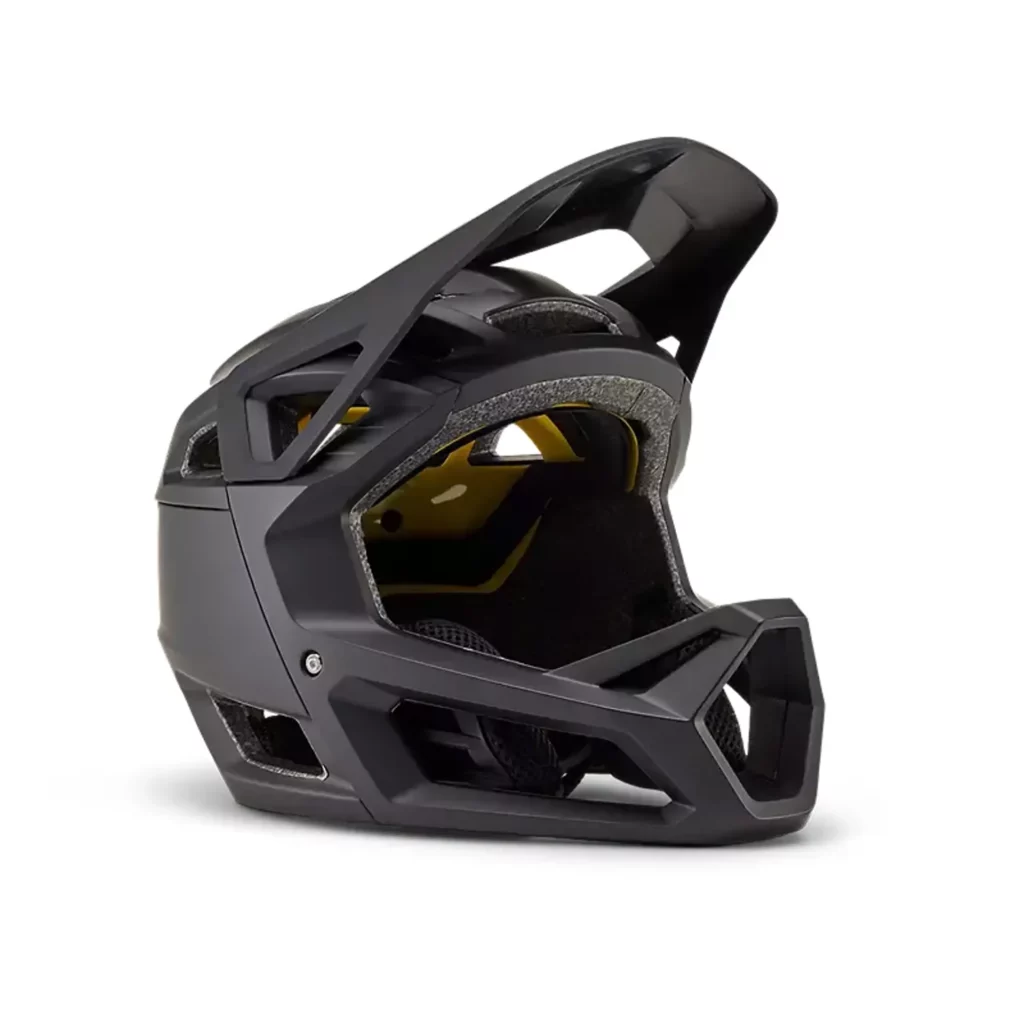
– Lightweight ventilated full face aimed at enduro/downhill
ABUS Targon MIPS Full-Face MTB Helmet
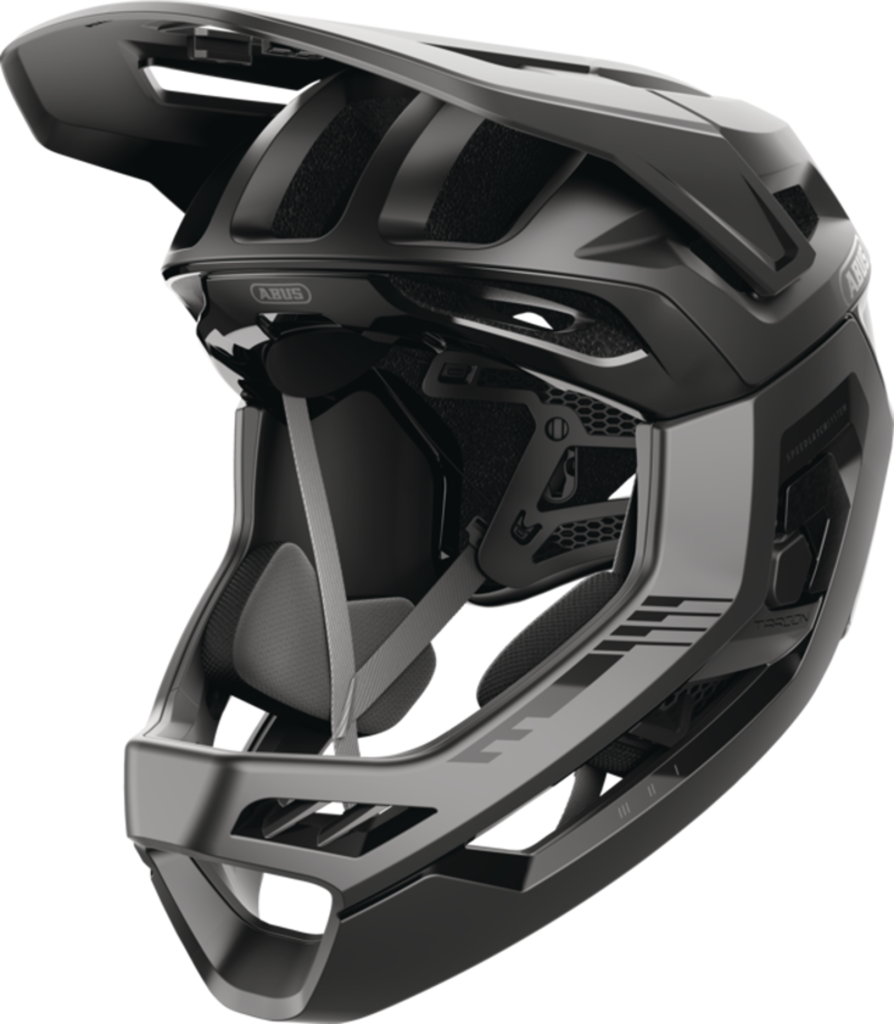
– Provides necessary protection in full-face mode. When riding uphill, the chin guard can be removed to increase airflow and easily carried on an arm or handlebars
Fox Rampage Camo Helmet 2026
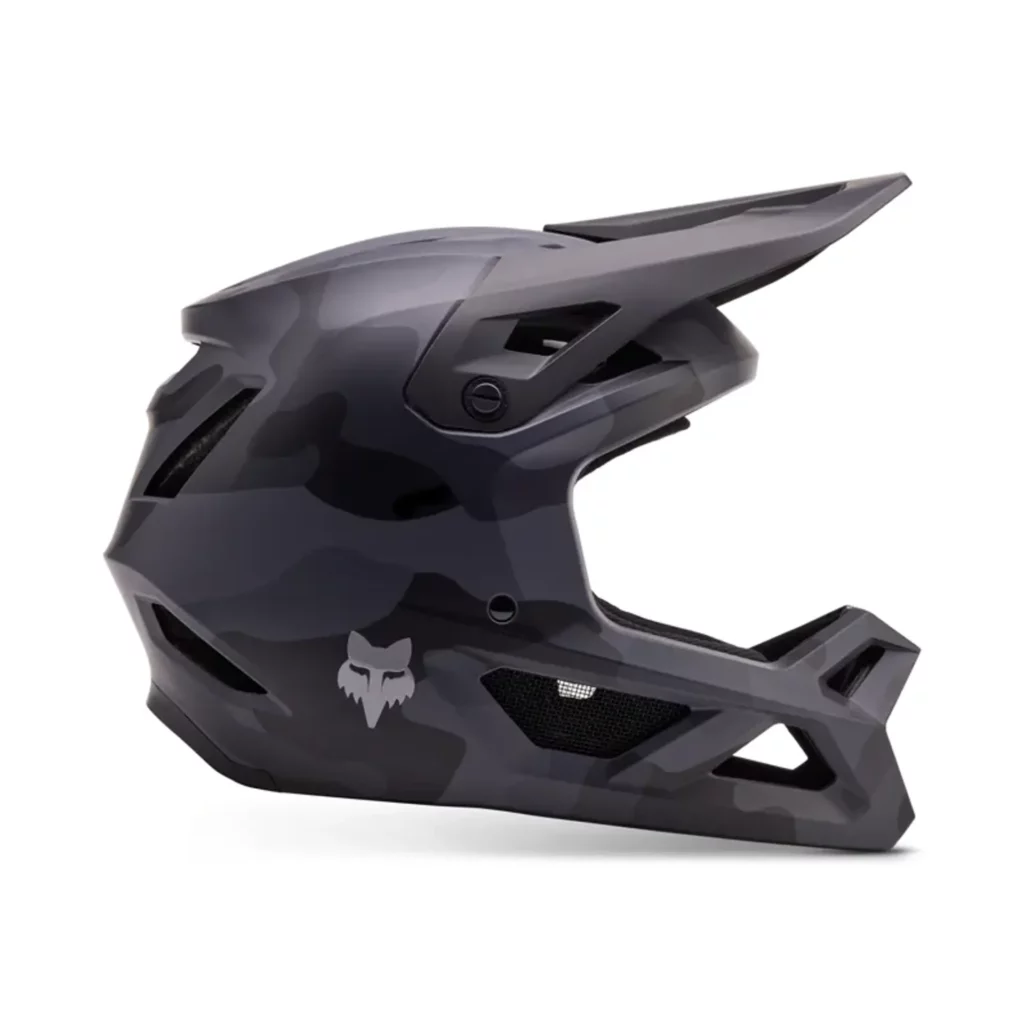
– features a lightweight, injection-molded ABS shell inspired by their The 360-degree ventilation provides superior airflow for all-day comfort, while Mips® technology reduces rotational forces transmitted to the brain during impact.
Please note: The certification is printed on a label inside the helmet shell. If it isn’t on the label, the helmet isn’t certified, regardless of what a product listing states.
How is an ASTM F1952 certified helmet tested?
Helmets are dropped onto anvils, including a kerbstone shaped anvil that simulates striking an edge, with impacts permitted anywhere on or above a defined test line. The retention system (strap and buckle) is tested before impact testing, and full face helmets undergo a dedicated chin bar impact test to ensure jaw protection. Helmets are conditioned in different environments for testing, so passing certification reflects performance in real-world conditions, not just a lab perfect sample.
Does F1952 test rotational impacts?
No. F1952’s impact tests measure linear forces. The straight line deceleration of your head hitting something. Rotational forces are a separate problem, addressed by technologies like MIPS rather than by the certification itself.
What is MIPS, and how does it relate to ASTM F1952?
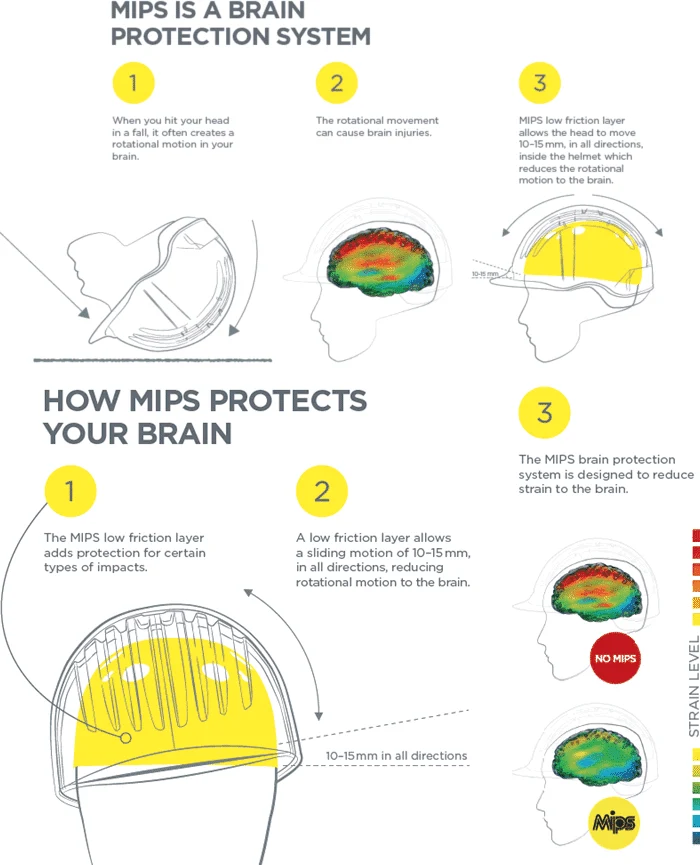
MIPS (Multi-directional Impact Protection System) is a low-friction layer fitted between a helmet’s padding and it’s shell. In an angled crash, which most real-world scenario’s are, that layer lets the helmet move slightly relative to the head, redirecting some of the rotational energy that would otherwise be transferred to the brain. Rotational motion is strongly associated with concussion, which is why the technology has become near-universal on mid-range and premium mountain bike helmets.
MIPS and F1952 differ in their reasoning for existing. F1952 certifies that a helmet withstands the linear impact forces of downhill riding. MIPS addresses the twisting forces a certification test doesn’t measure. One is not a substitute for the other, for gravity, or downhill riding, the strongest choice is a helmet that carries both, and most current downhill full face helmets do.
How do I compare rotation protection between helmets?
Certification labels wont tell you, no mainstream cycling standard scores rotational performance. However the independent Virginia Tech helmet ratings programme does, testing helmets for both linear and rotational protection and publishing star ratings, so it’s the best, and pretty much only free resource out there for comparing two helmets that both carry the same certifications.
Buying a full face helmet in Cornwall, UK
We stock full face helmets at our shop in Summercourt, just off the A30 between Mitchell and Indian Queens. A proper fitting helmet is the one thing a specification sheet can’t provide. Full face sizing runs slightly differently from open face helmets, and cheek pad fit makes or breaks comfort on long descents, so trying before buying genuinely matters. Come in or call us on 01872 487199 and we’ll size you properly before you head for the trails.