
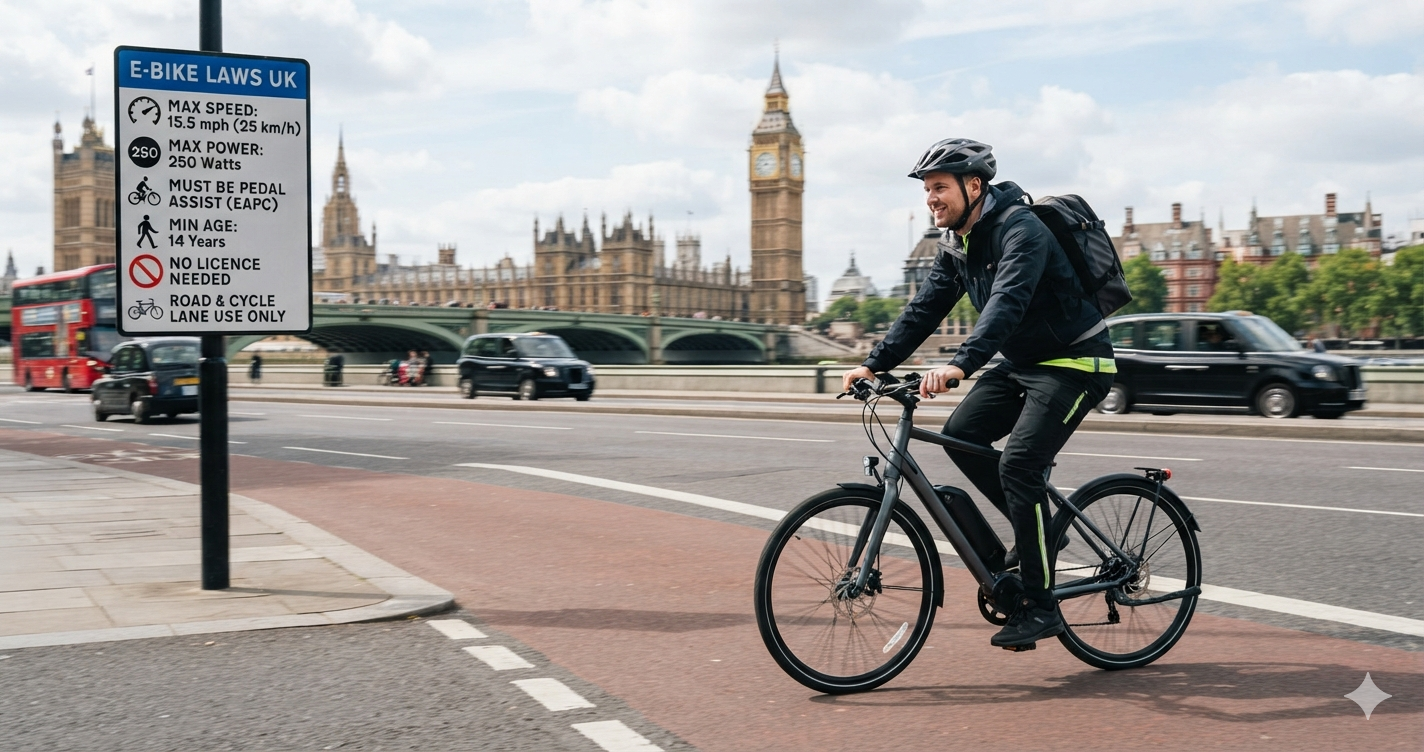
Thinking about an electric bike but unsure what’s actually legal? The rules are simpler than the internet makes them sound. In short: a UK-legal e-bike has a motor with a maximum continuous rated power of 250W motor, assists you up to 15.5mph, and you pedal it like a normal bike. No license, tax or insurance needed. Here’s the full picture.
The EAPC rules at a glance
A road-legal electric bike in Great Britain is called an EAPC – an Electrically Assisted Pedal Cycle. To qualify, a bike must comply with the following:
- Have a motor rated at 250W continuous power or less
- Stop assisting once you reach 15.5mph (25km/h) – you can pedal faster, the motor just won’t help
- Have working pedals that can propel the bike
- Display the manufacturer, motor power and battery details
- Be ridden by someone aged 14 or over
Meet all these requirements, and the UK law treats your e-bike exactly like an ordinary (analog) bicycle.
What you don’t need
This is the part that surprises some people. For a compliant EAPC, you do not need:
- A driving license
- Vehicle tax
- Insurance
- Registration or a number plate
A helmet also isn’t a legal requirement, however we’d always recommend wearing one. No ones too cool to not wear a helmet. If your e-bike meets the EAPC rules, you can buy it, ride it and park it anywhere just like any standard pedal bike.
Where can you ride a legal e-bike?
Anywhere you’re allowed to ride a normal bicycle: roads, cycle lanes and shared-use paths where cycling is permitted. The usual rules apply, lights after dark, care around pedestrians, and no riding on pavements where cycling isn’t allowed.
One thing worth knowing: a bike can be perfectly road legal and still be denied entry/storage on trains, bus or tube operators, as public transport companies set their own rules on carrying e-bikes. If you’re planning to take yours on the train, check the operator’s guidance first.
Throttle Only Electric Bikes
A lot of the confusion around e-bike laws comes down to throttles. Here’s the simple version.
- A walk-assist throttle that helps the bike along up to about 3.7mph (6km/h) without pedaling is fine.
- A “twist-and-go” throttle that powers the bike faster than walking pace without you pedaling needs specific type approval to be road legal. In practice to legally ride a bike with full throttle control up to 15.5 mph, it must be type-approved as a Low Powered Moped (L1e).
This matters because a lot of cheaper imported e-bikes sold online have full throttles that aren’t type-approved. They look like a bargain, but they aren’t legal to ride as a normal bicycle on UK roads, the Police can, and will stop you to confiscate the bike.
When is an E-bike illegal
If a bike goes beyond the EPAC limits — a motor over 250W, assistance past 15.5mph, or a non-compliant throttle, its not longer classed as a bicycle in the eyes of the law. It becomes a moped or a motorcycle, which means it needs registration, tax, insurance, a license, type approval and an approved helmet to be ridden legally on the UK roads.
Hopeful electric bike riders get caught out, usually in two ways
- High-powered imports advertised with eye-catching speeds and 500W, 750W or 1000W motors. These are not road-legal e-bikes in the UK.
- Illegal motor conversions – fitting a kit that pushes an ordinary bike beyond the legal limits. Beyond the legal issue, poorly made conversion kits and cheap batteries are also behind a worrying rise in battery fires, which is exactly why the cycling industry and safety bodies take this seriously.
The safest route is simple: buy a complete e-bike from a trusted brand and a proper bike shop. Bike shops including ours sell industry regulated electric bikes, so you don’t have to worry about any of these issues.
What about the “New 2026 e-bike law”?
You may have seen talk of the law changing. Here’s what actually happened.
Back in early 2024 the government consulted on two changes: raising the power limit from 250W to 500W, and allowing twist-and-go throttles up to 15.5mph without the type approval. After more than 2000 responses and a roughly even split of opinion, the proposals were dropped in February 2025 with the government concluding there wasn’t enough evidence to justify a change.
So despite headlines, nothing has changed. The 250 watt/15.5mph framework remains in place, and that’s the standard every legal e-bike sold here is built to. The government hasn’t ruled out revisiting this in the future, but for now the rules will remain the same.
Buying a legal e-bike with confidence
The good news is, you dont need to memorise any of this when you buy from the right place. Every e-bike in our electric bikes range is built to current UK EAPC rules.
E-bikes make a huge difference in the UK, Cornwall in particular, where the hills are relentless. If you’re weighing up whether electric is right for you, our guide comparing road, gravel, mountain and electric bikes is a good place to start. Whichever bike you choose, a proper Retül bike fitting makes sure it fits you properly, e-bikes are heavier, so a comfortable, efficient riding position matters even more.
Frequently asked questions
Do you need a license or insurance for an e-bike in the UK
No, not for a compliant Electrically Assisted Pedal Cycle (EAPC). As long as the bike has a 250W motor, cuts assistance at 15.5mph and has working pedals, its treated like an ordinary bicycle, so there’s no license, tax, insurance or registration required.
How fast can a legal e-bike go in the UK
The motor must stop assisting at 15.5mph (25km/h). You’re free to cycle faster than that under your own pedalling power, that law only governs how fast the motor will help you, not your top speed.
Are twist-and-go throttle e-bikes legal in the UK?
Only in very limited cases. A walk-assist throttle up to 3.7mph is fine, but a throttle that powers the bike faster than walking pace without pedalling needs specific type approval.
Is a 500W e-bike legal in the UK?
No. A 500W motor exceeds the 250W EAPC limit, so it isn’t a road-legal bicycle. The 2024 proposal to raise the limit to 500W was dropped in February 2025, so the 250W maximum rule still stands.
Do you have to wear a helmet on an e-bike?
There’s no legal requirement to wear a helmet on a standard EAPC, but its strongly recommended. (If a bike falls outside of EAPC rules and is classed as a moped or motorcycle, an approved helmet then becomes a legal requirement.)
This guide covers the law in Great Britain (England, Scotland and Wales) and is for general information, not legal advice. For the official position, see the government’s e-bike guidance at gov.uk/electric-bike-rules. Rules can change, so if in doubt, ask us or check the latest official guidance before you buy/ride.