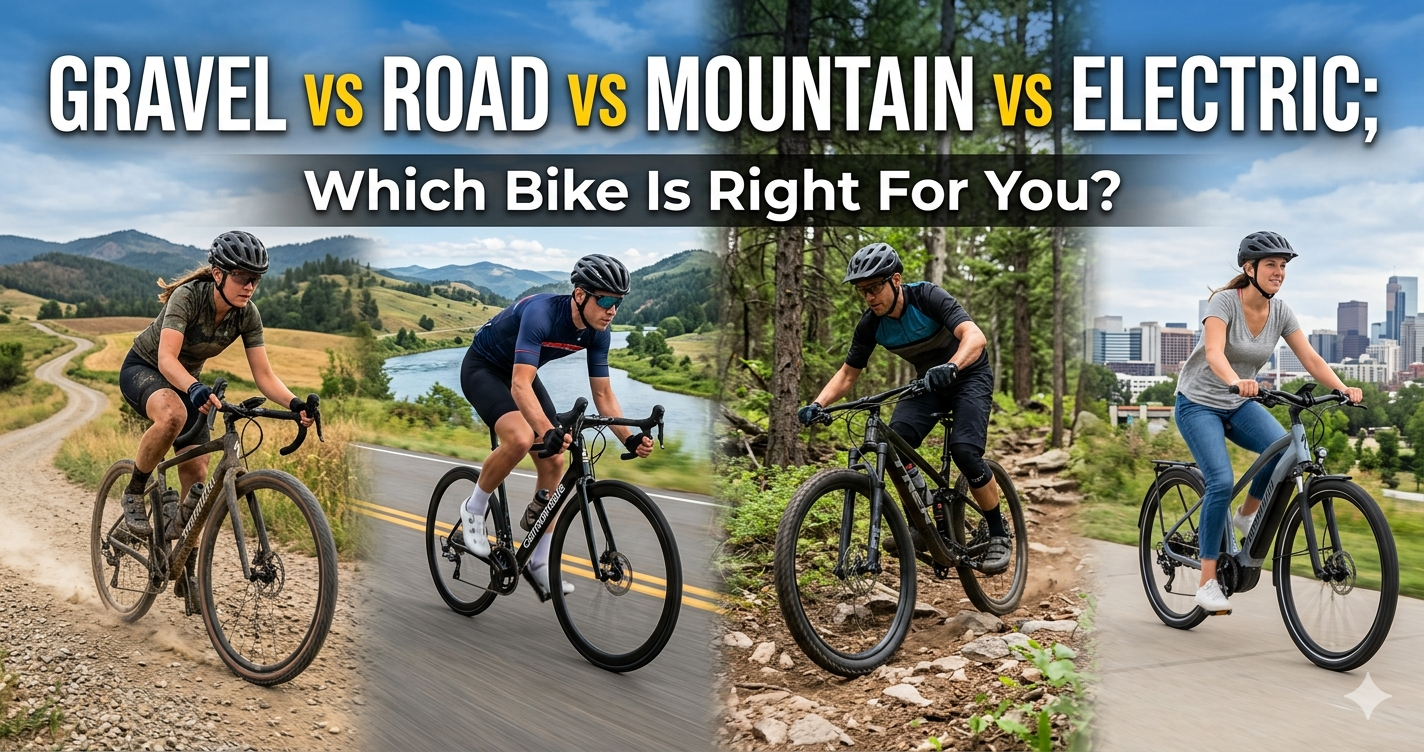
Choosing your next bike comes down to one question: where do you want to ride it? Road bikes are built for speed on tarmac, mountain bikes for rough off-road trails, and gravel bikes sit in-between as the all rounder. The Electric version of all of these bikes adds variable pedal assistance on top — a real help in hilly areas, especially the elevations down in Cornwall. Here’s how to pick the right one.
The quick answer
- Road Bike – fastest on tarmac, lightest, best for fitness, distance and sportives.
- Mountain Bike – built for trails, roots and descents, with suspension and grippy tyres.
- Gravel Bike – the all rounder; road bike pace with the freedom to leave the tarmac
- Electric Bike – electric version of any of the above, with a motor to assist your pedalling; ideal for hills, commuting, age-related or mobility restrictions, and riding further with less effort.
If you mostly ride one surface, go specific. If you cycle mixed lanes, tracks and the odd trail.. which in the UK, most riders do — a gravel bike is usually the smart choice, and if you hate hills with a passion, going electric will give the assistance needed to stomach the climbs.
Road bikes: built for speed
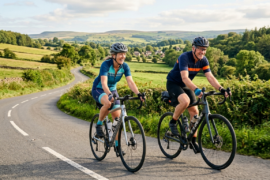
A road bike is hard to beat on tarmac. Lightweight frames, narrow tyres and a low, aerodynamic position make them efficient over long distance. Ideal if your goal is fitness, longer rides, or working towards cycling races and a sportive.
The trade-off is the unforgiving nature of road bikes on rough surfaces. Those skinny tyres and stiff frames are fast on smooth roads, but your buttocks will take the brunt of rough surface impacts when you leave the tarmac. If your riding is road miles, club runs and the occasional event, this is your bike.
Have a look at our road bikes range, where we stock Cube, Specialized, Pinarello, and Whyte models from entry-level through to performance builds.
Gravel bikes: the all-rounder
Gravel bikes are the most versatile bikes you can buy, and it’s no surprise they’ve become so popular, especially around Cornwall. They look much like a road bike but with wider, grippier tyres, a more relaxed geometry. With bigger tyre clearance and more frame stability, gravel bikes handle lanes, byways, towpaths and light off-road trails without complaint.
For alot of riders, a gravel bike is a sensible single-bike answer: quick enough to keep up on a road ride, capable enough to take the scenic off-road route home. If you want to understand the category properly, our complete guide to gravel bikes goes deeper on geometry, tyres and what to look for.
Browse our gravel bikes to see what’s currently in.
Mountain bikes: built for the rough stuff
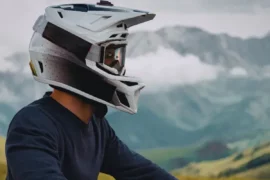
If your riding is genuinely mostly off-road, trail centres, technical descents, rocks, roots and mud — a mountain bike is the right tool. The suspension soaks up impacts, wide knobbly tyres find grip, and the upright, control-focused position keeps you confident when the trail gets steep or the surface loose.
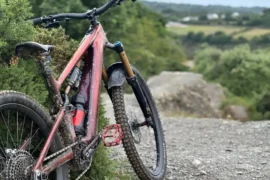
The main decision within the MTB category is hardtail versus full suspension. A hardtail (front suspension only) is lighter, simpler and better value, a great all-round trail bike. Full suspension adds a rear shock for comfort and control on rougher, faster terrain, albeit at a higher price. On the road though, a mountain bike will always feel slow and heavy, that’s the cost of all that capability.
See our mountain bikes range for Cube, Specialized, and Whyte hardtail and full-suspension options.
Electric bikes: assistance when you want it
Here’s the thing most people don’t realise: an electric bike (e-bike) isn’t a separate type of bike, its an electrified version of the main bike categories. You can have e-road bike, an e-gravel bike, or an e-mountain bike. Each one rides like its non-assisted counterpart, with a motor that helps you pedal, with plenty of higher tech accessories like lights and computers that tend to be internally wired. There are also relaxed geometry hybrid e-bikes, built mainly for commuting and leisure, as well as folding electric bikes for city cycling and easier transport.
The motor on electric bikes reduces the muscular effort of the legs. You still pedal, the motor just assists, alot of ebikes have varying assistance levels that can be changed via the computer system. Its worth noting that the UK law states that pedal assistance cuts out at 15.5mph on road legal e-bikes, also known as Electrically Assisted Pedal Cycle (EAPC).
Climbs, headwinds and longer distances stop being a limiting factor, in Cornwall, where there’s barely a flat mile to be found, an ebike can be transformative to your cycling experience. Routes you’d have normally written off become genuinely enjoyable, you’ll arrive at the top of the climb with energy to spare.
E-bikes suit a lot of riders: commuters who don’t want to arrive sweating, anyone returning to cycling after injury or a long break, riders who want to keep up with fitter friends, and those who want to go for a nice day out exploring without expending all their energy before lunch. The two things to weigh up are weight (e-bikes are heavier) and range (how far the battery lasts on a charge).
Take a look at our electric bikes range, covering e-road, e-gravel, e-folding, e-touring, and e-MTB.
Still not sure? How to choose
Work backwards from your riding, not the bike:
- Mostly smooth roads, want speed and fitness? Road bike.
- Mix of lanes, tracks and the odd trail? Gravel Bike.
- Proper off-road trails and descents? Mountain Bike
- Are the hills, the distance or the effort holding you back? Add electric to any of the above.
Two of those decisions can stack together: you might want an e-gravel bike for hilly mixed-surface rides, or an e-road bike to keep up on the club run. Electric isn’t a compromise, it’s the same bike, with motor pedal assistance.
Frequently asked questions
Can you use a gravel bike on the road?
Yes. Gravel bikes ride well on tarmac, a little slower than a dedicated road bike because of the wider tyres, but perfectly capable for road miles. Fitting faster-rolling tyres closes much of that gap if most of your riding is on the road.
Is a gravel bike or a mountain bike better for Cornwall?
It depends on your routes. For a mix of quiet lanes, towpaths and a light off-road, a gravel bike is ideal. For genuine trail centres and technical descents, a mountain bike is the better tool. Many riders here find a gravel bike covers the widest range of what Cornwall offers.
Do you still get exercise on an electric bike?
Yes! Of course, you still pedal the whole time, the motor just reduces the effort. Some specific cycling studies, and riders alike find e-bikes owners tend to ride more often and further than they would on an analog bike. So total exercise often goes up rather than down, pedal assistance can obviously be controlled depending how hard you want to work.
Is an electric bike worth it in Cornwall?
For most people here, yes. The hills are relentless, and assistance is exactly what makes them manageable — whether you’re commuting, riding with fitter friends, or just want to enjoy the views on your day trip without dreading the climb home.
Hardtail or full suspension for a beginner?
For most beginners, a hardtail is the better starting point: lighter, simpler, better value and capable across plenty of trails. Step up to full suspension when you’re regularly riding rougher, faster, more technical trails and require the extra control.
How much should I spend on my first bike?
Spend what gets you a reliable bike for your preferred riding, entry-level models from trusted brands like Cube and Specialized are well-built and will last. It’s better to buy a good bike that fits than an expensive one that doesn’t suit your riding.
Clive Mitchell Cycles Blog
Ride on Pard!